Control Module: vfd
A variable-frequency drive with a recipe-commandable run/speed and a
hardware-fast fault interlock. This template is pump-agnostic. Use it
for any VFD-controlled load (pump, fan, agitator, mixer, compressor).
Operator or recipe logic writes the RUN_CMD (run/stop) and SPEED_SP
(speed setpoint) tags. Each is backed by a constant block, exactly like
solenoid-valve and analog-control back their writable CMD. The
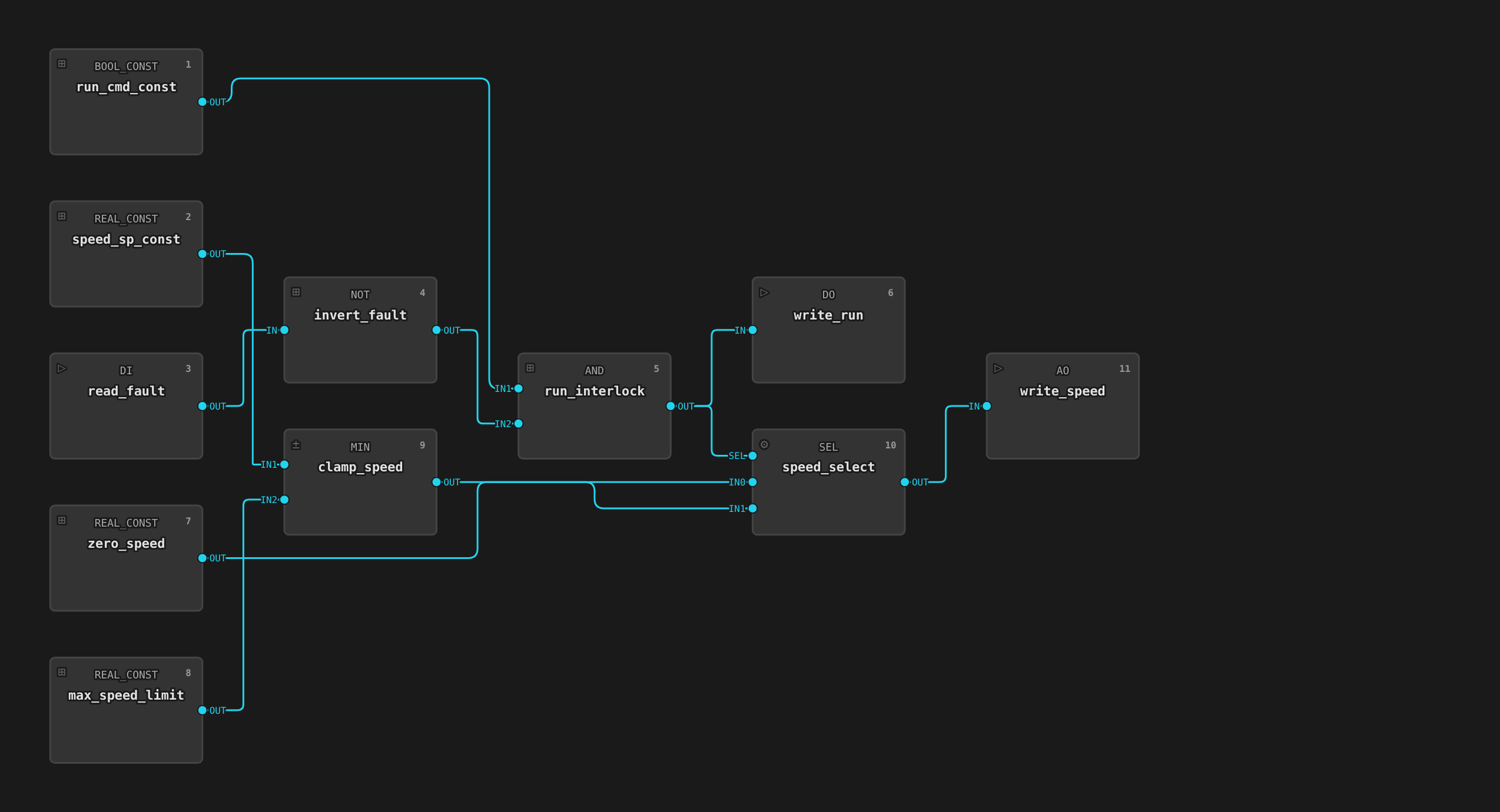
template AND-gates the run command with the inverted fault signal, so
the drive is disabled in the same scan cycle on any fault. When
running, the speed setpoint is clamped to max_speed. When stopped or
faulted, the speed output is forced to zero.
Where to find it
System endpoint → Equipment Library → Control Modules tab → select vfd.
What you see on the faceplate
| Element | Meaning |
|---|---|
| RUN_CMD | Run/stop command (read-write — operator or recipe) |
| SPEED_SP | Speed setpoint, 0–max_speed (read-write — operator or recipe) |
| FAULT | VFD fault input state (read-only) |
| RUN | Interlocked run enable delivered to the drive (read-only) |
| SPEED | Effective speed output delivered to the drive, 0–max_speed (read-only) |
The RUN tag already reflects the fault interlock. If FAULT = true,
RUN is forced false and SPEED is zero regardless of what RUN_CMD
or SPEED_SP are doing.
Tags
The template declares deviceClass: actuator and a role on each tag
(ADR 0016). The HMI renders
from these declarations and never infers meaning from moduleType or
tag names. The RUN tag's role: state
makes it the unit card's prominent status word (rendered with the
CM-level true_label/false_label, Running/Stopped).
SPEED_SP (role: setpoint) fills the HMI setpoint bar and SPEED
(role: feedback) the feedback bar.
| Tag | Type | Access | Role | Description |
|---|---|---|---|---|
RUN_CMD |
Boolean | read-write | command |
Run command. Operator or recipe ST writes TRUE/FALSE; backed by a BOOL_CONST block. |
SPEED_SP |
Float | read-write | setpoint |
Speed setpoint (0–max_speed). Operator or recipe ST writes the value; backed by a REAL_CONST block. |
FAULT |
Boolean | read | alarm |
VFD fault status (from fault input). Exposed so an AlarmDefinition can wrap it with severity and exception action. |
RUN |
Boolean | read | state |
Interlocked run enable written to run_out. true only when RUN_CMD = true AND FAULT = false. Shown as the card's prominent status word. |
SPEED |
Float | read | feedback |
Effective speed written to speed_out. Equals clamped(SPEED_SP, max_speed) while running, zero otherwise. |
ILCK |
Boolean | read | interlock |
true while the device interlock is forcing the output to its safe state. Reserve a TagTrue AlarmDefinition for interlocks whose trip is abnormal in itself (why). The historian records every trip either way. |
Parameters
| Parameter | Default | What it does |
|---|---|---|
max_speed |
100.0 |
Upper clamp on the speed setpoint, same units as SPEED_SP |
eng_units |
(blank) | Display units for SPEED / SPEED_SP (e.g. %, Hz, RPM) |
true_label |
Running |
Faceplate label when the drive is active (shown for the RUN state tag; RUN_CMD carries its own per-tag Run/Stop labels) |
false_label |
Stopped |
Faceplate label when the drive is off |
interlockAddress |
(empty — interlock disabled) | Device address of a boolean trip signal, read by the output block every scan; while tripped (or unreadable — fail-safe) the output is forced to the safe value. |
interlockInvert |
false |
Trip while the signal is false (with the invert off, true trips). |
safeValue |
(empty) | Output value forced while interlocked. Applies to the speed output; empty means the output range minimum. The run command always drops to stopped while tripped. |
Setting interlockAddress on an instance enables the device interlock.
See Alarms and Interlocks → Pattern 0.
The former state_tag parameter is replaced by the RUN tag's
role: state designation. The card reads Running/Stopped, the
live interlocked state. The RUN_CMD verbs Run/Stop belong to the
command alone.
Scan interval is fixed at 100 ms. The fault interlock is the driving constraint: slow scan rates defeat the same-cycle guarantee.
How it works
Each scan cycle, the runtime:
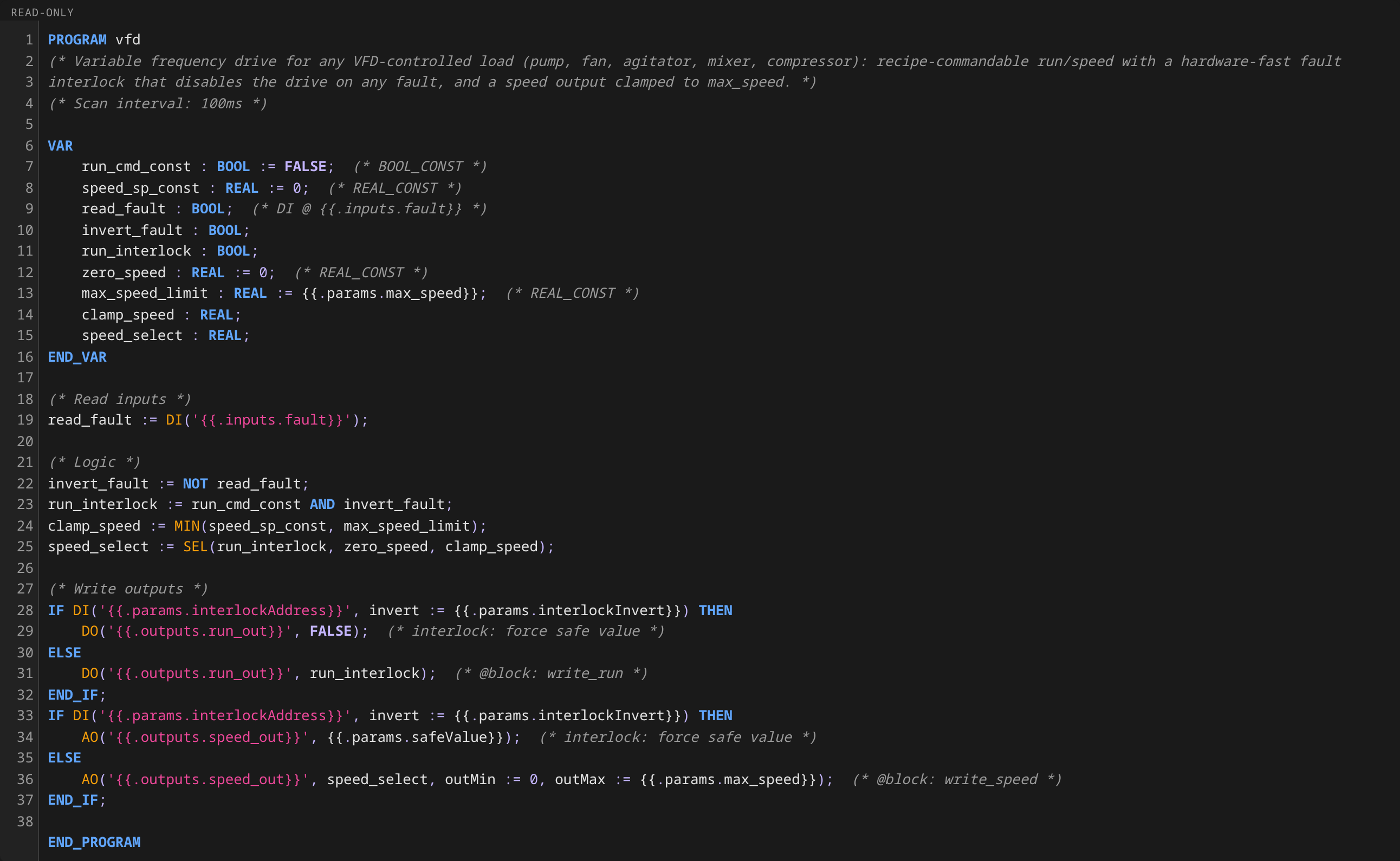
- Takes the latest
RUN_CMD(Boolean) written by operator/recipe. - Reads
fault(Boolean) →FAULTtag. - Computes
RUN = RUN_CMD AND NOT FAULTand writes torun_out. - Takes the latest
SPEED_SP(Float), clamps withMIN(SPEED_SP, max_speed). - Selects
SPEED = clamped_speed if RUN else 0.0, writes tospeed_out.
Steps 3 and 5 are deterministic within one scan. That is the
hardware-fast interlock guarantee. The FAULT tag is also exposed
for an AlarmDefinition to wrap (typical pattern: TagTrue with
exceptionAction: Hold so the batch pauses for operator
acknowledgement even though the drive itself has already dropped out).
Why the interlock lives in the network
Most diagnostic signals (MISMATCH, DEV_ALARM) are raised as tags
and wrapped by AlarmDefinition for debounce, severity, and action,
keeping the control module stateless. VFD fault is the exception.
Drives can damage themselves or their loads in hundreds of
milliseconds, faster than a Kubernetes-hosted alarm reconciler can
react. The in-network AND-gate ensures the drive output is zero the
moment the fault arrives, independent of alarm handling. The
AlarmDefinition then handles batch-level response (hold, operator
acknowledgement) on top of the already-safe hardware state.
Failure modes
- Fault signal stuck high — drive never runs. Visible as
RUN_CMD =
  true, FAULT = true, RUN = false
. Check wiring and the VFD fault contact. - Fault signal stuck low during an actual fault — the in-network
interlock can't help because the tag lies. This is why the
AlarmDefinitionwrap is still valuable: it gives a second line of evidence (e.g. overcurrent observed on the analog-sensor wrapping motor current) that can hold the batch independently. - Speed setpoint above
max_speed— silently clamped. If you want to alarm on attempted overdrive, wrapSPEED_SP(not the internalSPEEDtag) withAlarmDefinition(TagHigh).
Reference instances
| Deployment | Unit | Instance | Purpose |
|---|---|---|---|
| newark-plant | granulator-1 | impeller-motor |
Main impeller drive for dry mixing and wet granulation |
The impeller motor pairs with an analog-sensor called
impeller-current that monitors VFD current draw. HH/H alarms on
impeller-current.PV catch over-torque (binding). L/LL catch belt
slip or empty bowl. The vfd template owns the fast fault interlock.
The analog-sensor + AlarmDefinitions own the slower diagnostic loop.
Try it
On newark-plant:
- Process → newark-plant → granulator-1
- Click the impeller-motor symbol on the unit detail view
- Write
SPEED_SPand toggleRUN_CMD— observeRUNandSPEEDrespond - Force
fault = truevia the IOModule simulation — observeRUNdrops tofalseandSPEEDto zero within one scan cycle, and theimpeller-motor-faultAlarmDefinition holds any running batch